

Free Shipping in Ireland (ROI and the North) on orders over €35 and above.

Michael Dooley’s poems have appeared in Banshee, the Irish Independent, Poetry Ireland Review, The Stinging Fly, and have been broadcast on RTÉ Radio One. His debut collection, In Spring We Turned to Water (Doire Press), was shortlisted for the Farmgate Café National Poetry Award, and was jointly awarded the Southword Debut Poetry Collection Award. He is a teacher and lives in Co. Limerick.
Dooley gives the pastoral tradition back its teeth and claws, and gives us, with ecstatic, imaginative and intricate observation, poems of transformation and revelation
— Stephen Sexton
He broke horses when chasers
were in the paddock on slow wet afternoons —
broke the careful silence of a newly backed filly:
‘Treat the reins as if they were velvet.’
He broke fasts with dawn prayers
under cracked-ridge saddles
and paint-flakes held in cobweb —
murmurs of Leviticus.
He broke his nose in an alley
in Charleville in 1982
fighting a traveller
for five hundred pounds.
He broke himself
in fits of compunction,
sending what little he had to Africa,
or to a satellite Evangelical.
He broke the yellow
stained glass of the
back-door when he
was ‘put through it.’
He broke his skin,
leaning over
a shotgun,
in 1994.
He broke his wife.
Horses, in exhaustion,
horses.
We pulled the roof off of the milking parlour,
sheet by sheet, drew square cut nails like teeth —
thunder-snap and peeling crack on concrete,
bouncing big-eyed kittens from their bales.
It opened like a wound, the pit, though we’d picked,
when we should have not, its hardened line of steel.
Rafters steamed by wet-day cows, introduced again to light.
In their hue, the strange and awful tone of opened bone.
Cows cautioned their step into this roofless place,
saw strangeness of stars when Dad milked at dawn,
hungered and herded dog-less to the yard,
greedy for the winter silage opened in June.
So we watered fields, tore up river like a weed,
the vacuum tank a dung-chen prayer
for hedgehogs found curled into knots in the dust,
swallow chicks who stepped out into oblivion.
Prayers, too, in the milking quiet between us:
stories of men, of fodder and strain,
how the heat was walking them into parlours,
giving them answers to questions they’d never need again.
Review of In Spring We Turned to Water by Michael Dooley (Doire Press)
Review by Jessica Traynor
Poetry Ireland Review Issue 146, edited by Stephen Sexton
“Michael Dooley’s Farmgate Prize-winning (sic) debut, In Spring We Turned to Water, ushers us into a landscape in which myth, history, and the present day collide. These poems are shot through with a kind of magical realism, and like the best magical realism, they don’t shy away from the darker side of life; in these rural-set poems, much loved animals die (whether by accident or design), game birds are shot, and the speaker in the poems finds themself having to take on the role of unwilling killer, or witness to slaughter. It’s the emphatic quality of these poems that really allows us to feel the loss, such as in the striking opening poem, ‘Sweet Pea’, where a beloved horse is transformed at the moment of death:
I lean down to calm her,
wet bridle in my hands,
when her poll breaks out in flower,
the mane in olive pods.
Another striking horse poem, ‘Votive’, weaves a kind of pagan magic from an act of killing so visceral it seems to blast a hole through time and space, forcing the perpetrators (who have acted out of mercy) to confront their nature as killers: ‘the whiteness of a disbelieving eye / when baskets of his bowels fell picknicked/ / in our hands, marking us’. These poems exhort us to imagine the acts we’re capable of, alongside great love – not only as individuals, but as communities.
Whereas the other two collections concern themselves with seascapes and wetlands, Dooley’s is a riverine collection, gliding us through the farmlands of his upbringing. These rivers, more than simply providing water and nourishment, are also liminal spaces. In an atmospheric sequence of poems dispersed throughout the collection and prefaced with ‘River,…’, we are immersed in these ever-changing riverscapes where timelines bleed into one another:
On the far bank, Wild Sullivan’s sucklers turn away from me and go still.
They are watching a figure cross the field; something ill-defined,
a ghost or a hunted priest, the Marcach maybe. How they part and show
him to water like a man damned. - (‘River, at Dusk)
It would be easy to be lulled by the deftness of Dooley’s phrasemaking, and the musicality of the language, but there is a serious reckoning here with what it means to be alive that admits not only beauty, but the reality of violence, and the spectre of grief. These are intricate poems which animate their subjects with careful attention.”
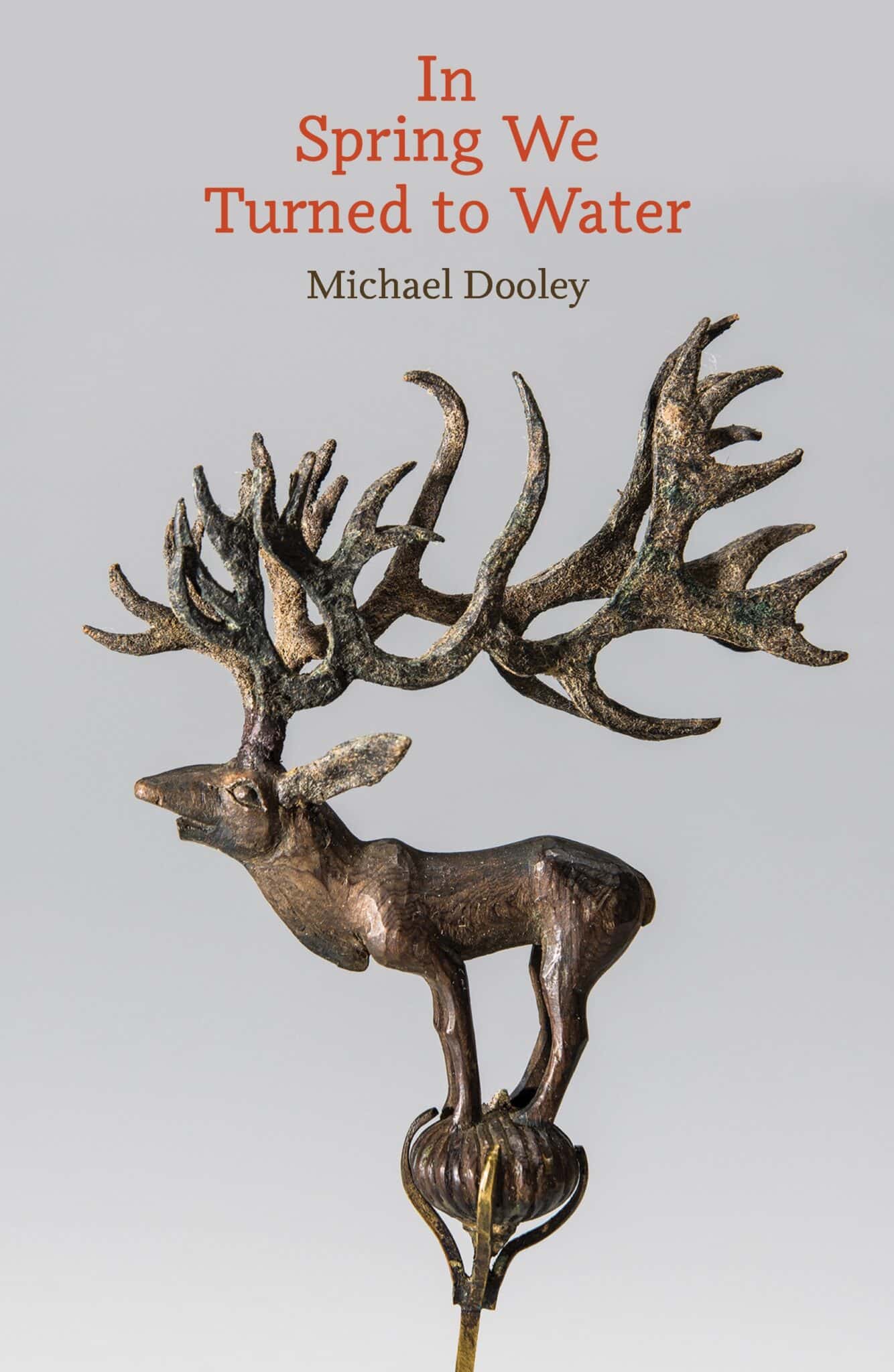
ISBN: 978-1-915877-01-7| Pages: 80 pages / Hardback | Year published: 2024
In Spring We Turned to Water is the first full-length collection of poetry from Michael Dooley. It brings together poems of intricate watchfulness and stunning revelation from the natural world. In parts memory and experience, parts lore and the dreamlike, these visually striking and distinctly sounded poems emerge from a liminal terrain tightly charged with folklores and heritages, water bodies, outsiders, and wild creatures.